
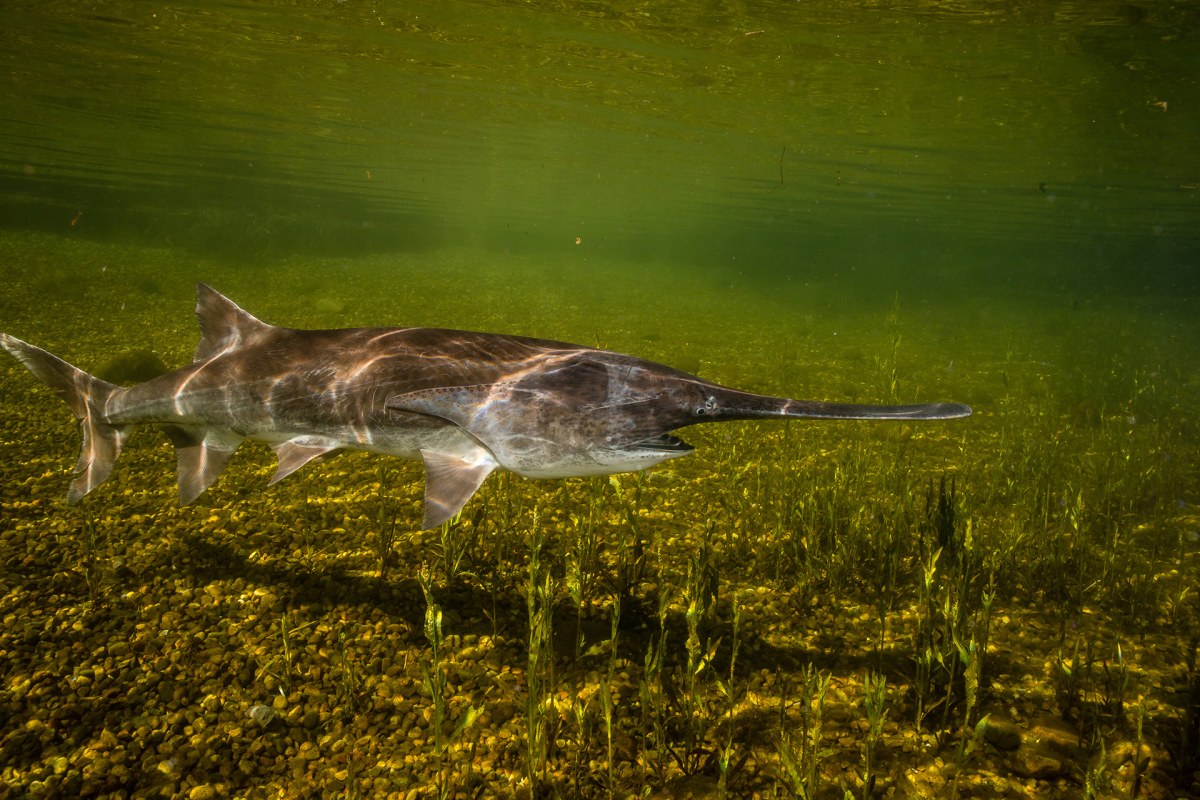
The American Paddlefish - "Polyodon spathula"
The American Paddlefish is a large prehistoric fish with a very large mouth, and a long, paddle-shaped snout (called a rostrum) that is about one-third the length of the body. The American Paddlefish has a historical range that once spanned from as far west as Montana and Texas, eastward to the Allegheny River in New York and Pennsylvania. The Paddlefish is native to the Mississippi River Watershed, as well as the Great Lakes watershed, however, they are now considered extirpated from the Great Lakes watershed.
Diet
Paddlefish are filter feeders, feeding mostly on tiny animals called zooplankton by using filament-like gill rakers to filter zooplankton from the water. The rostrum (paddle-shaped snout), of a paddlefish is an important tool that is used while foraging and feeding. The rostrum is a sensory organ that is covered in electroreceptors that can detect weak electrical field emitted by zooplankton. This helps paddlefish effectively and efficiently forage for their main prey souce, zooplankton. Paddlefish will also eat aquatic insects, and occasionally small fish.
Did you know?
Paddlefish can grow up to 7 feet long,and weigh up to almost 200 pounds.
Report all Sightings
Paddlefish live in Allegheny Reservoir as a result of a cooperative reintroduciton by various agencies. In order to protect them, possession is prohibited.
If you catch a paddlefish, release it back into the water.
Report all sightings to one of the listed agencies:
New York State DEC
- Location and date where seen, including the name of the water body in western NY and a nearby landmark. If in Pennsylvania and within 20 miles of New York please also tell us.
- How it was observed (caught by angling, seen swimming in the water, dead on shore, etc.) If the fish is deceased, saving and freezing the anterior 6” of the snout could allow biologists to determine the age or stocking history of the fish.
- Approximate length of the fish; and a photo if available.
Pennsylvania Fish and Boat Commission
Report to the Northwest Fisheries Management Office: 814-359-5118
Seneca Nation of Indians
Report to the Allegany Seneca Conservation Office: 716-945-8155
Population Decline
During the 19th Century, the blocked migration from the construction of dams limited the ranges and disrupted the migratory breeding behavior of paddlefish. Areas that were previously spawning grounds for the American Paddlefish were unable to be reached. There are now several areas that now must be annually stocked by local conservation agencies to maintain their population. Poor water quality and the reduction of zooplankton abundance have also lead to a decline in Paddlefish populations throughout a substantial portion of their native range. By the early 1900s, Paddlefish were extirpated from New York State. The NYS Department of Environmental Conservation began a stocking program in 1998 to help restore the Paddlefish in the Allegheny Reservoir and River. Paddlefish are listed as a species of Special Concern in New York State.
Life History
Paddlefish typically live for about 15 years, however 30-50 year old Paddlefish are not uncommon. Males reach sexual maturity at about 7-9 years, and will often spawn every year. Females reach sexual maturity at about 9-12 years, and will take 2-7 years in between spawning events. Spawning typically occurs in late spring or early summer when water temperatures increase to about 50-65 degrees Fahrenheit, and water flows increase. Paddlefish can migrate large distances (50 to 200 miles) to flooded, fast-flowing tributaries, to spawn. Young of the year Paddlefish grow rapidly to avoid predation from fish such as Walleye.
Habitat
Paddlefish prefer slow moving rivers and backwater areas rich in plankton, as well as large reservoirs and lakes. Paddlefish require access to large, free flowing rivers containing gravel bars that become inundated by spring floods for spawning.
Learn More
To view more information about the Paddlefish in New York State, Click Here
To view the "Paddlefish" kiosk panel that is located at Onoville Marina Park, Click Here